
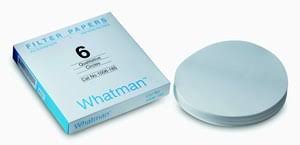
Cellulose filters are used in qualitative analytical techniques to determine and identify materials.
Prepleated qualitative filters are available, which give improved flow rate and increased loading capacity compared to equivalent flat filters.
| Variation Codes | 1006-090 |
|---|
Based on 0 reviews
Be the first to review “Qualitative Filter Papers-Grade 6: 3μm”
Related products
-
Whatman
Mixed Cellulose Ester Membranes-Plain ME 24, Gridded
Whatman gridded filters have clearly defined grid lines spaced at 3.1 or 5 mm intervals.
The special ink used is nontoxic and completely
free from bacterial growth inhibitors.Whatman black mixed cellulose esters are available plain for automatic colony
counting applications, as well as gridded to assist in manual counting procedures.Black membranes provide contrast between residue or cell colors and the filter
without having to counter-stain the membrane.SKU: n/a -
Whatman
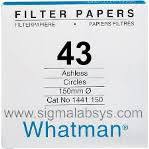
Quantitative Filter Papers-Grade 43: 16μm
Grade 43: 16 μm*
Intermediate in retention between Grades 40 and 41, and twice as fast as Grade 40.Typical applications include foodstuffs analysis, soil analysis, particle collection in
air pollution monitoring for subsequent analysis by XRF techniques, and inorganic
analysis in the construction, mining, and steel industries.SKU: n/a -
-
Whatman
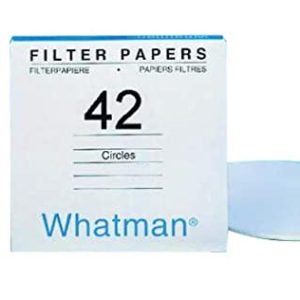
Quantitative Filter Papers-Grade 42: 2.5μm
Grade 42: 2.5 μm*(Ashless Grades)
Used for critical gravimetric analysis with the finest particle retention of all
Whatman cellulose filter papers.Typical analytical precipitates include barium sulfate, metastannic acid, and finely precipitated calcium carbonate.
SKU: n/a
There are no reviews yet.