
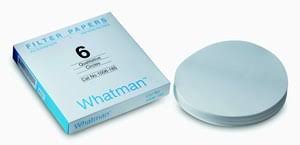
Cellulose filters are used in qualitative analytical techniques to determine and identify materials.
Prepleated qualitative filters are available, which give improved flow rate and increased loading capacity compared to equivalent flat filters.
| Variation Codes | 1006-090 |
|---|
Based on 0 reviews
Be the first to review “Qualitative Filter Papers-Grade 6: 3μm”
Related products
-
Whatman
Glass Microfiber Filter with Binders-Grade GF 10 -Inorganic Binder
Grade GF10 Reel 35 mm x 30 m Core 70 mm 1/PK
This filter with extreme mechanical stability and temperature resistant up to 180°C is used
as a weighing aid for infrared weighing and as a roll filter in automatic air filtration units.SKU: n/a -
Whatman
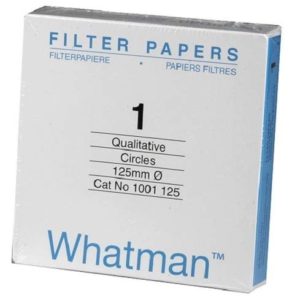
Qualitative Filter Papers – Grade 1: 11µm
Grade :Grade 1
Grade Type :Standard
Typical Particle Retention in Liquid1 :11 µm
Nominal Thickness :180 µm
Typical water flow rate2 :57 ml/min
Nominal Basis Weight :87 g/m²
Nominal Air Flow Rate :13 s/100 ml/in²
Nominal Ash Content :0.06%
Material :CelluloseFormat :Sheets
Dimensions :580 x 680 mm (22 x 26 in)
Pack size :100 piecesSKU: n/a -
Whatman
Mixed Cellulose Ester Membranes-Plain ME 24, Gridded
Whatman gridded filters have clearly defined grid lines spaced at 3.1 or 5 mm intervals.
The special ink used is nontoxic and completely
free from bacterial growth inhibitors.Whatman black mixed cellulose esters are available plain for automatic colony
counting applications, as well as gridded to assist in manual counting procedures.Black membranes provide contrast between residue or cell colors and the filter
without having to counter-stain the membrane.SKU: n/a -
Whatman
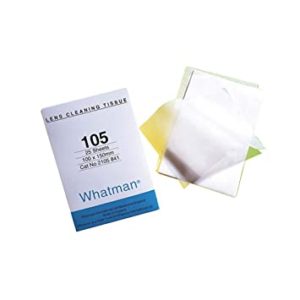
Lens Cleaning Tissue
Lenses and other optical surfaces made from glass, quartz or plastic can be easily
scratched if you do not clean them with a very soft surface.High-quality Whatman
lens cleaning tissue provides the solution. The tissue is chemically pure and free
from silicones and other additives.Most importantly, it can be relied on to safely remove surface moisture and grease.
SKU: n/a
There are no reviews yet.