
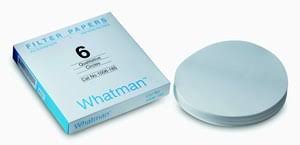
Cellulose filters are used in qualitative analytical techniques to determine and identify materials.
Prepleated qualitative filters are available, which give improved flow rate and increased loading capacity compared to equivalent flat filters.
| Variation Codes | 1006-090 |
|---|
Based on 0 reviews
Be the first to review “Qualitative Filter Papers-Grade 6: 3μm”
Related products
-
Whatman
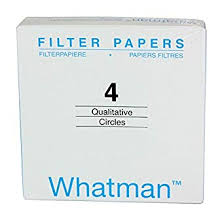
Qualitative Filter Papers-Grade 4: 20-25μm
Extremely fast filtering with excellent retention of coarse particles and gelatinous
precipitates such as ferric hydroxide and aluminum hydroxide.Very useful as a rapid filter for routine clean-up of biological fluids or organic extracts during analysis.
Used when high flow rates in air pollution monitoring are required and the collection of fine particles is not critical.
Available prepleated as Grade 4V.
SKU: n/a -
Whatman
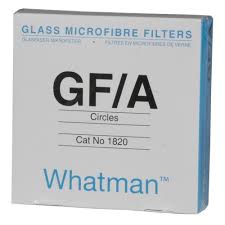
Glass Microfiber Filters-Binder Free Glass Microfiber Filters- Grade GF/A (1.6 μm)
Offers fine particle retention and high flow rate, as well as good loading capacity.
Used for high-efficiency general purpose laboratory filtration, including water pollution monitoring of effluents, for filtration of water, algae and bacteria cultures, food stuff analyses, protein filtration, and radioimmunoassay of weak ß emitters.
Recommended for gravimetric determination of airborne particulates, stack sampling, and absorption
methods of air pollution monitoring.SKU: n/a -
Whatman
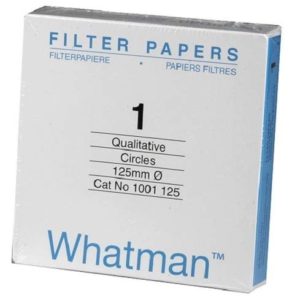
Qualitative Filter Papers – Grade 1: 11µm
Grade :Grade 1
Grade Type :Standard
Typical Particle Retention in Liquid1 :11 µm
Nominal Thickness :180 µm
Typical water flow rate2 :57 ml/min
Nominal Basis Weight :87 g/m²
Nominal Air Flow Rate :13 s/100 ml/in²
Nominal Ash Content :0.06%
Material :CelluloseFormat :Sheets
Dimensions :580 x 680 mm (22 x 26 in)
Pack size :100 piecesSKU: n/a
There are no reviews yet.