

Qualitative Filter Papers-Grade 5: 2.5μm
10 in stock
Grade 5: 2.5 μm*
The maximum degree of fine particle filtration in the qualitative range.
Capable of retaining the fine precipitates encountered in chemical analysis.
Slow flow rate.
Excellent clarifying filter for cloudy suspensions and for water and soil analysis.
Also available prepleated as Grade 5V.
Price range: Rs.1,507.50 through Rs.5,092.50
Comparecellulose filters are used in qualitative analytical techniques to determine and identify materials.
Prepleated qualitative filters are available, which give improved flow rate and increased loading capacity compared to equivalent flat filters.
| Variation Codes | 1005-090, 1005-110, 1005-125, 1005-185 |
|---|
Based on 0 reviews
Be the first to review “Qualitative Filter Papers-Grade 5: 2.5μm”
Related products
-
Whatman
Extraction Thimbles-HP Cellulose Extraction Thimbles
Cellulose extraction thimbles are produced from high-quality alpha cellulose cotton
linter and have excellent mechanical strength and retention.
Standard single thickness thimbles have a wall thickness of approximately 1 mm
(10.0 μm nominal particle retention).SKU: n/a -
Whatman
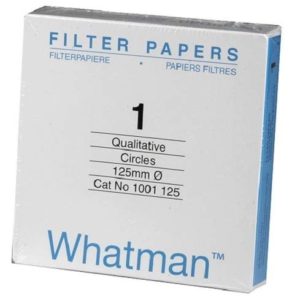
Qualitative Filter Papers – Grade 1: 11µm
Grade :Grade 1
Grade Type :Standard
Typical Particle Retention in Liquid1 :11 µm
Nominal Thickness :180 µm
Typical water flow rate2 :57 ml/min
Nominal Basis Weight :87 g/m²
Nominal Air Flow Rate :13 s/100 ml/in²
Nominal Ash Content :0.06%
Material :CelluloseFormat :Sheets
Dimensions :580 x 680 mm (22 x 26 in)
Pack size :100 piecesSKU: n/a -
Whatman
Quantitative Filter Papers-Grade 42: 2.5μm
Grade 42: 2.5 μm*(Ashless Grades)
Used for critical gravimetric analysis with the finest particle retention of all
Whatman cellulose filter papers.Typical analytical precipitates include barium sulfate, metastannic acid, and finely precipitated calcium carbonate.
SKU: n/a -
Whatman
Quantitative Filter Papers-Grade 43: 16μm
Grade 43: 16 μm*
Intermediate in retention between Grades 40 and 41, and twice as fast as Grade 40.Typical applications include foodstuffs analysis, soil analysis, particle collection in
air pollution monitoring for subsequent analysis by XRF techniques, and inorganic
analysis in the construction, mining, and steel industries.SKU: n/a


There are no reviews yet.