
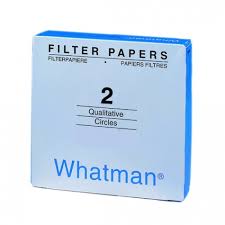
Qualitative Filter Papers – Grade 2: 8µm
10 in stock
Slightly more retentive than Grade 1 with a corresponding increase in filtration time (i.e., slightly slower filtration speed).
More absorbent than Grade 1. In addition to general filtration in the 8 μm particle size range, the extra absorbency is utilized, for example, to hold soil nutrient in plant growth trials.
Also used for monitoring specific contaminants in the atmosphere and in soil testing.
Price range: Rs.1,072.50 through Rs.1,912.50
CompareCellulose filters are used in qualitative analytical techniques to determine and identify materials.
Prepleated qualitative filters are also available, which give improved flow rate and increased loading capacity compared to equivalent flat filters.
| Variation Codes | 1002-090, 1002-110, 1002-125, 1002-150 |
|---|
Based on 0 reviews
Be the first to review “Qualitative Filter Papers – Grade 2: 8µm”
Related products
-
Whatman
Nuclepore Track-Etched PC Membranes
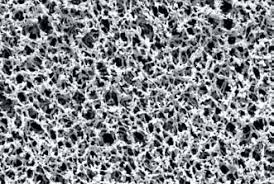
Nuclepore track-etched polycarbonate membranes are manufactured from high-quality polycarbonate film and have sharply defined pore sizes, high flow rates, and excellent chemical and thermal resistance.
The membranes have a smooth flat surface and exhibit very low levels of extractables.
SKU: n/a -
-
Whatman
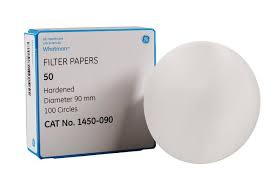
Quantitative Filter Papers-Grade Grade 50: 2.7μm
Grade 50: 2.7 μm*
Retention of very fine crystalline precipitates.The thinnest of all Whatman filter papers with a slow flow rate, these filters have a hardened and highly glazed surface, which also keeps the paper free from loose surface fibers.
Highly suitable for
qualitative or quantitative filtrations requiring vacuum assistance on Büchner
or 3-piece filter funnels.Very strong when wet and will withstand wet handling and
precipitate removal by scraping.In the electronics industry, the virtual absence of
fiber shedding is utilized in carriers for integrated circuits.This grade is also available in Smear Tab format for wipe testing (e.g. testing of
surfaces for radionuclide contamination).SKU: n/a -
Whatman
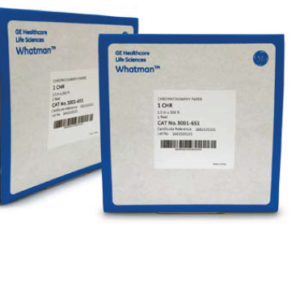
Chromatography Papers-Grade 1 CHR
Whatman chromatography paper media are made from specially selected cotton cellulose.
They are rigorously quality controlled for characteristics important to the chromatographer and to ensure uniformity within
the grade.Features and benefits
• Pure cellulose produced entirely from the highest quality cotton linters
with no additives of any kind
• Manufactured and tested specifically for chromatographic techniques –
this ensures the wicking capability and uniformity of capillary action that
are important in chemical separations
• Also widely used in protein and nucleic acid blottingSKU: n/a

There are no reviews yet.