
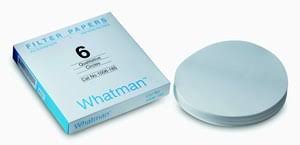
Cellulose filters are used in qualitative analytical techniques to determine and identify materials.
Prepleated qualitative filters are available, which give improved flow rate and increased loading capacity compared to equivalent flat filters.
| Variation Codes | 1006-090 |
|---|
Based on 0 reviews
Be the first to review “Qualitative Filter Papers-Grade 6: 3μm”
Related products
-
Whatman
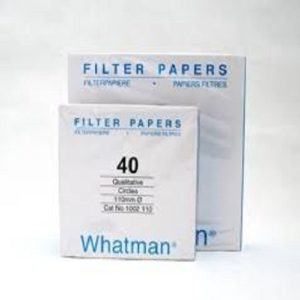
Quantitative Filter Papers-Grade 40: 8μm
Grade 40: 8 μm*
The classic general purpose ashless filter paper with medium speed and retention.
Typical applications include gravimetric analysis for numerous components in cements,clays, iron, and steel products; as a primary filter for separating solid matter from aqueous extracts in general soil analysis; quantitative determination of sediments in milk, and as a pure analytical grade clean-up filter for solutions prior to AA
spectrometry.Also used as a high-purity filter in the collection of trace elements and radionuclides from the atmosphere.
SKU: n/a -
Whatman
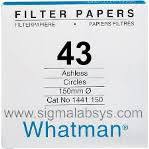
Quantitative Filter Papers-Grade 43: 16μm
Grade 43: 16 μm*
Intermediate in retention between Grades 40 and 41, and twice as fast as Grade 40.Typical applications include foodstuffs analysis, soil analysis, particle collection in
air pollution monitoring for subsequent analysis by XRF techniques, and inorganic
analysis in the construction, mining, and steel industries.SKU: n/a -
Whatman
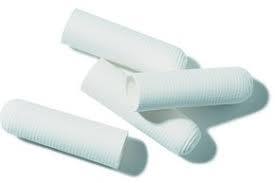
Extraction Thimbles-HP Cellulose Extraction Thimbles
Cellulose extraction thimbles are produced from high-quality alpha cellulose cotton
linter and have excellent mechanical strength and retention.
Standard single thickness thimbles have a wall thickness of approximately 1 mm
(10.0 μm nominal particle retention).SKU: n/a -
Whatman
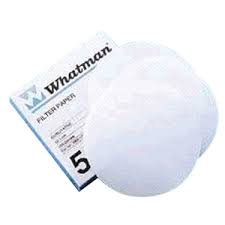
Qualitative Filter Papers-Grade 5: 2.5μm
Grade 5: 2.5 μm*
The maximum degree of fine particle filtration in the qualitative range.Capable of retaining the fine precipitates encountered in chemical analysis.
Slow flow rate.
Excellent clarifying filter for cloudy suspensions and for water and soil analysis.
Also available prepleated as Grade 5V.
SKU: n/a
There are no reviews yet.